This article provides a comparative analysis between water electret vs standard electret meltblown nonwovens.
Key filtration performance metrics like initial efficiency, resistance to temperature/humidity, and loading behavior are examined. Structural differences in fiber size, pore structure, and morphology are also reviewed.
Experiments showed water electret nonwovens exhibited higher initial filtration efficiency, better charge stability, lower pressure drop, and sustained performance during loading stages. However, standard electret nonwovens may still suit some cost-sensitive applications.
Manufacturers should evaluate the enhanced filtration capabilities and permanence of water electret technology versus the economics of standard electrets when selecting the optimal material for their specific meltblown nonwoven needs.
Before we dive in, you also should know this is an EP-6 product knowledge page, if you need to order our EP-6 series water electret masterbatches (WEMBs), you can visit here: EP-6. If you need a free samples for product production testing, you can go to: Free Samples.
Introduction of Materials and Post Intentions
1.1 What are water electret masterbatch based meltblown nonwovens and electret masterbatch based meltblown nonwovens?
Meltblown nonwovens are a class of nonwoven filter fabrics comprised of micro and nanoscale fibers produced through a meltblowing process. The small fiber diameters provide high surface area for capturing particles.
To impart electrostatic filtration enhancement, electret masterbatches are incorporated during manufacturing. The electret additives introduce semi-permanent electrostatic charges to the fiber matrix. This creates an electret filter media.
Standard electret masterbatches rely on techniques like corona discharge to impart electrical charges. However, water electret masterbatches utilize a novel water-based process to impart charges during formation of the polymer emulsion.
This water-based charging achieves higher initial electrostatic charge levels and improved charge stability compared to standard electret masterbatches. The permanent electrostatic enhancement creates meltblown filters with excellent filtration efficiency.
For more basic knowledge, please refer to:
- What is Water Electret Masterbatch? And how is the 99%+ filtration rate achieved?
- Benefits of water electret masterbatch and our EP-6: What new properties have meltblown nonwovens gained with the use of water electret masterbatches?
- What is Water Electret Meltblown and Why is it the most important revolution in nonwovens technology?
- or E-BLOG: All You Need to Know about Water Electret Masterbatch
1.2 Why we want to compare the differences between water and standard electret meltblown nonwovens
While standard electret meltblown nonwovens have been widely used in filtration applications, the new water electret technology offers potential advantages. However, adoption requires evaluation of the costs and benefits compared to existing standard electret materials.
By comparing important metrics like initial filtration efficiency, durability of the electrostatic charge, resistance to temperature and humidity, fiber structure, and loading behavior, we can quantify the enhancements of water electret nonwovens.
This analysis will help manufacturers determine if the improved performance of water electret nonwovens justifies the change in manufacturing methods required. It may suit next-generation filters where maximum capture efficiency and low pressure drop are essential.
Alternatively, standard electret nonwovens may still be preferred for some cost-sensitive, high-volume filtration media if the increase in performance does not warrant the additional investments needed to shift production to water electret technology.
By benchmarking water against standard electret nonwovens, we aim to provide manufacturers the data needed to make informed decisions about adopting water electret meltblowns for their specific filtration applications and business needs.
Before we start the big comparison, please note that:
THIS COMPARATIVE EVALUATION BETWEEN WATER AND STANDARD ELECTRET MELTBLOWN NONWOVENS IS BASED ON FINDINGS FROM THE RESEARCH PAPER “PREPARATION AND PROPERTIES OF MELT-BLOWN POLYPROPYLENE WATER ELECTRET NONWOVEN MATERIALS” BY CHEN ET AL., 2022. EXPERIMENTS IN THAT STUDY ANALYZED KEY FILTRATION PERFORMANCE METRICS AND MATERIAL PROPERTIES FOR A CONTROL MELTBLOWN NONWOVEN, ALONG WITH VERSIONS TREATED WITH CORONA DISCHARGE AND WATER ELECTRET MASTERBATCHES. THE RESULTS DEMONSTRATED SIGNIFICANT ADVANTAGES IN INITIAL EFFICIENCY, CHARGE STABILITY, AND SUSTAINED PERFORMANCE FOR THE WATER ELECTRET NONWOVENS. REFERENCE WILL BE MADE TO THE DATA AND CONCLUSIONS FROM CHEN ET AL. TO SUBSTANTIATE THE COMPARISONS MADE THROUGHOUT THIS ARTICLE.
Evaluating Differences in Filtration Performance
2.1 Comparing initial filtration efficiency values
According to the research paper by Chen et al., initial filtration efficiency was tested for three meltblown polypropylene nonwoven samples:
- An uncharged control sample
- A sample treated with standard corona discharge electret
- A sample treated with the water electret process
The uncharged control meltblown nonwoven exhibited a baseline filtration efficiency of 43%. This represents the inherent efficiency contribution from the fiber matrix itself without any electrostatic enhancement.
The corona discharge treated electret nonwoven showed significant improvement with an initial filtration efficiency of 96.48%. This demonstrates the filtration boost provided by the electrostatic charges imparted through the standard corona discharge electret process.
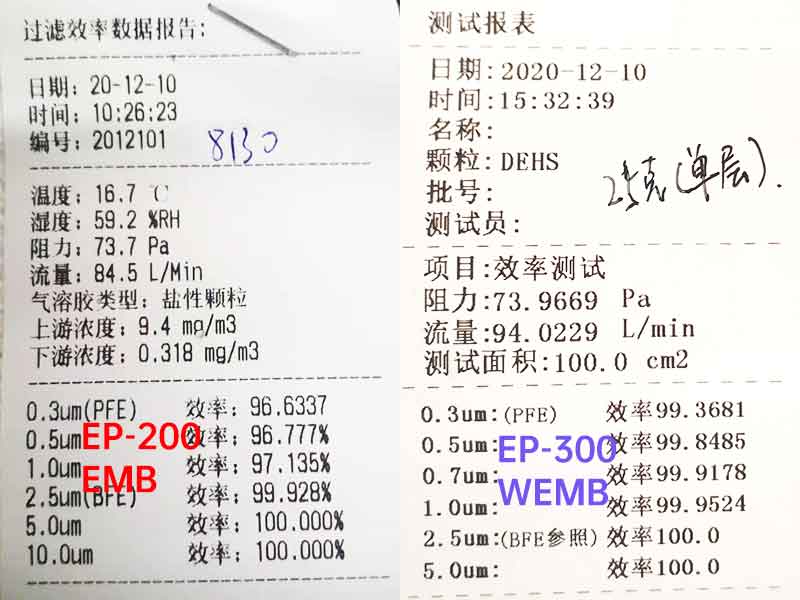
Most notably, the water electret nonwoven achieved a 99.89% initial filtration efficiency in the paper’s results. This represents a major increase compared to the 96.48% efficiency of the standard electret nonwoven.
The substantially higher initial efficiency indicates the water-based electret charging method is able to introduce a greater level of electrostatic enhancement versus corona discharge. This electrostatic boost results in superior particle capture, with the water electret nonwoven providing near 100% filtration at the start.
| Type | Initial filtration efficiency |
|---|---|
| Uncharged control sample | 43% |
| Standard corona discharged | 96.48% |
| Water electret process charged | 99.89% |
2.2 Comparing changes in filtration efficiency at different temperatures
The paper examined how filtration efficiency for the water and corona discharge electret nonwovens changed when exposed to elevated temperatures over 48 hours.
At 90°C, the water electret nonwoven’s efficiency only dropped slightly from 99.89% down to 98.83%. In contrast, the corona discharge electret nonwoven’s efficiency fell significantly from 96.48% down to 82.27% at 90°C.
When tested at 100°C, the water electret nonwoven maintained high efficiency around 99%, while the corona discharge nonwoven’s efficiency deteriorated to 70.47%.
At 110°C, the water electret nonwoven only declined to 98.56% efficiency after 48 hours. However, the corona discharge nonwoven dropped further to 75.27% efficiency.
The minor efficiency loss for the water electret versus substantial degradation for the corona discharge electret highlights the improved thermal stability of the water electret nonwovens. The water-based charging method appears to impart electrostatic charges that are far less susceptible to dissipation at elevated temperatures.
| Type / Filtration efficiency | Initial | Temperature at 90°C | Temperature at 100°C | Temperature at 110°C |
|---|---|---|---|---|
| Standard corona discharged | 96.48% | 82.27% | 70.47% | 75.27% |
| Water electret process charged | 99.89% | 98.83% | 99% | 98.56% |
2.3 Comparing changes in filtration efficiency under different humidity
The research also examined how humidity impacted filtration efficiency over time for the two electret nonwovens.
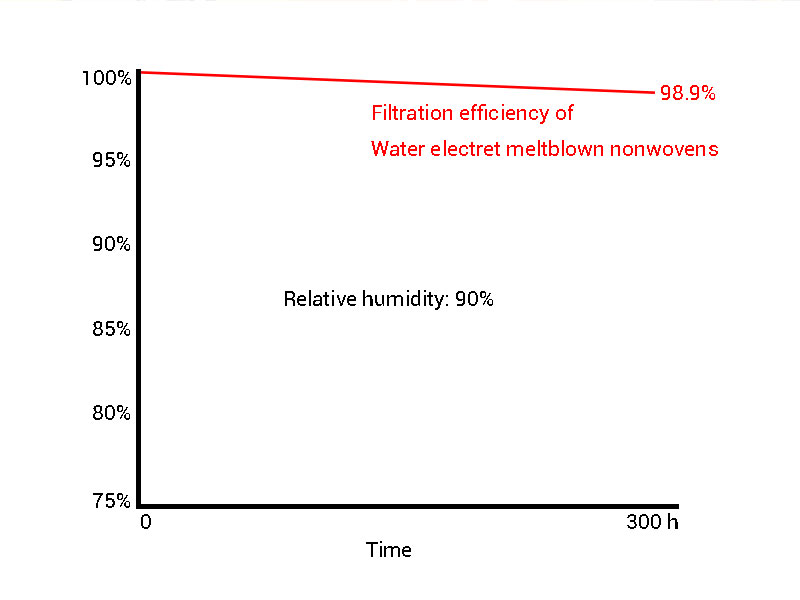
When exposed to 90% relative humidity at 25°C for 350 hours, the water electret nonwoven showed only a minor 1% decrease in efficiency from 99.96% down to 98.87%.
In comparison, the corona discharge electret nonwoven exhibited a larger efficiency drop of approximately 6% under the same 90% humidity conditions, falling from 96.81% down to 92.68%.
Additionally, the water electret nonwoven maintained stable efficiency over the duration, while the corona discharge nonwoven experienced more fluctuations during the humidity exposure.
The minimal impact of high humidity on the water electret nonwoven versus the larger degradation for the standard electret nonwoven further demonstrates the superiority of water-based charging for achieving permanent electrostatic enhancement.
| Type / Filtration efficiency | Initial | Humidity at 90% |
|---|---|---|
| Standard corona discharged | 96.81% | 92.68% |
| Water electret process charged | 99.96% | 98.87% |
2.4 Comparing changes in filtration efficiency at different air flow rates
The research evaluated how filtration efficiency changed during particle loading stages for the two electret nonwovens across varying air flow rates.
At higher flow rates of 60 and 85 L/min, both electret samples experienced an initial dip in efficiency followed by recovery. This is attributed to neutralization of fiber charges by the NaCl particles.
However, the water electret nonwoven reached its lowest efficiency point faster than the corona discharge nonwoven at both 60 and 85 L/min flows. This indicates the water electret’s electrostatic effect diminished more rapidly.
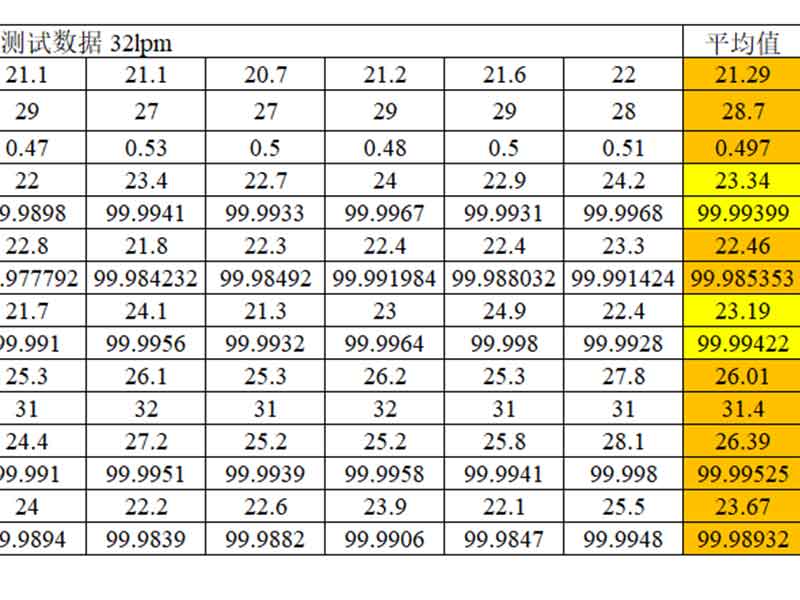
At a lower 32 L/min flow, the water electret maintained higher efficiency throughout the 60 minute loading. Its electrostatic effect decayed more slowly at lower face velocity.
In contrast, the corona discharge electret experienced faster efficiency reduction at all tested flow rates. It saw substantial degradation even at 32 L/min.
The flow rate response demonstrates the water electret’s superiority at lower face velocities, while highlighting potential limitations at higher flows.
Assessing Variations in Air Resistance
3.1 Comparing initial air resistance values
In addition to filtration efficiency, the research examined differences in air flow resistance, measured by pressure drop.
The initial pressure drop of the untreated meltblown control sample was 22.37 Pa. This provides a baseline resistance value with no electrostatic enhancement.
The corona discharge electret treatment did not significantly alter the pressure drop, only increasing it slightly to 22.96 Pa.
However, the water electret nonwoven exhibited a noticeably lower initial pressure drop of 19.62 Pa compared to the control and corona discharge samples.
This indicates the water electret process, which involves high pressure water jet impacting, increased the nonwoven’s permeability and porosity. The higher porosity yielded lower airflow resistance.
The lower pressure drop is advantageous, allowing higher airflow and throughput while maintaining filtration efficiency. This highlights another potential benefit of water electret enhancement.
| Type | Air resistance (Pa) |
|---|---|
| Uncharged control sample | 22.37 |
| Standard corona discharged | 22.96 |
| Water electret process charged | 19.62 |
3.2 Comparing the change of resistance at different temperatures
The research also evaluated how exposure to elevated temperatures impacted air resistance over time.
When tested at 90°C, 100°C, and 110°C for 48 hours, both the water and corona discharge electret nonwovens maintained stable pressure drop. Neither experienced significant increases.
The water electret nonwoven had lower resistance than the corona discharge nonwoven at all tested temperatures. Its pressure drop remained around 19-20 Pa, while the corona nonwoven was around 22-23 Pa.
The stable pressure drop indicates neither electret treatment was detrimentally affected by the thermal exposure. The lower resistance advantage of the water electret nonwoven was maintained.
The results demonstrate that the enhanced permeability and lower pressure drop imparted by the water electret process provided sustained benefits even after high temperature exposure.
3.3 Comparing the change of resistance under different humidity
The study also evaluated changes in air resistance when exposed to high humidity over an extended duration.
When tested at 90% relative humidity for 350 hours, both the water and corona discharge electret nonwovens exhibited minimal increases in pressure drop over time.
The water electret maintained its advantage of lower resistance around 19-20 Pa, while the corona discharge electret remained around 22-23 Pa.
The results indicate the high humidity exposure did not negatively impact the porosity or permeability for either electret nonwoven. The lower pressure drop benefit of the water electret treatment was preserved.
This demonstrates the resistance advantages enabled by the water electret process provide sustained benefits even under high humidity conditions over long time periods.
3.4 Comparing the change of resistance under different flow rates
The study examined differences in pressure drop changes when the electret nonwovens were loaded with particles at various air flow rates.
At lower face velocities like 32 L/min, both electret samples showed gradual pressure increase over the 60 minute loading test. The water electret maintained lower resistance.
However, at higher flows of 60 and 85 L/min, pressure drop increased more rapidly after around 35 minutes for both samples as particle deposition increased.
The water electret nonwoven experienced lower resistance increases compared to the corona discharge nonwoven at 60 and 85 L/min flows.
But particle loading caused substantial pressure rise in both samples at higher velocities, reducing the water electret’s advantage.
The results indicate potential limitations of the water electret nonwoven at higher loading conditions with elevated air flow. But it maintained lower resistance at lower face velocities.
Reviewing Other Property and Structural Differences
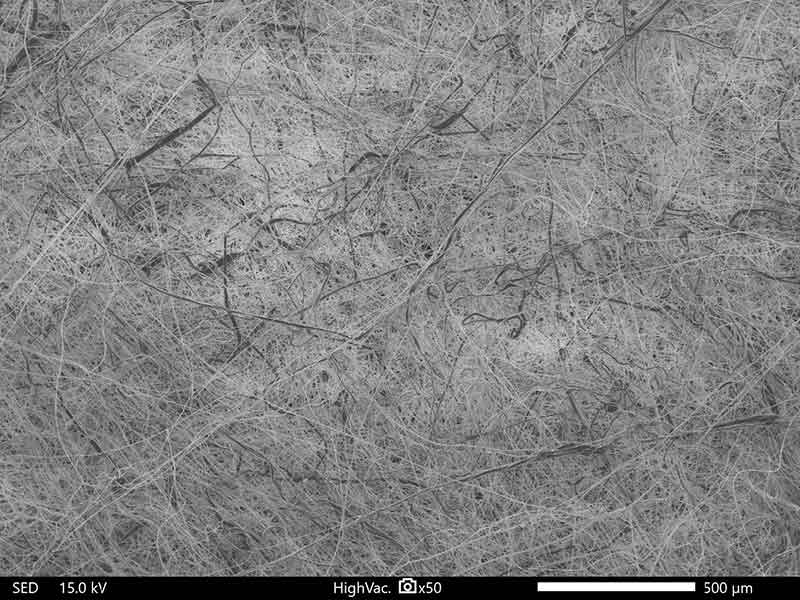
4.1 Comparing fiber diameter
The study characterized fiber diameters for the meltblown nonwovens using SEM imaging analysis.
All three samples exhibited small fiber diameters in the range of 1-3 μm. This micro and nanoscale fiber matrix provides the high surface area for filtration.
Both the water and corona discharge electret treatments did not significantly alter the base fiber diameters. All fibers remained in the 1-3 μm range.
Therefore, the fiber diameters were comparable across the control, corona discharge electret, and water electret nonwovens. The electret enhancements did not change this key structural parameter.
4.2 Comparing pore size and porosity
Analysis of the pore structure using porosimetry revealed key differences between the two electret nonwovens:
The control and corona discharge electret nonwovens had similar porosity around 83% and pore sizes around 13 μm.
However, the water electret nonwoven exhibited larger pores around 16 μm and higher porosity around 90%.
The increased porosity and pore size are attributed to the high pressure water jets during the water electret process opening up the fiber matrix.
This correlates to the lower pressure drop by enabling easier airflow through a more open structure.
4.3 Comparing fiber structure
While SEM imaging did not reveal obvious differences, the paper notes that the water electret treatment did impact fiber structure and morphology versus the control and corona discharge samples.
The untreated meltblown control showed a typical mixture of coarse crude and fine fibers. The corona discharge electret appeared similar with a minute change towards finer fibers.
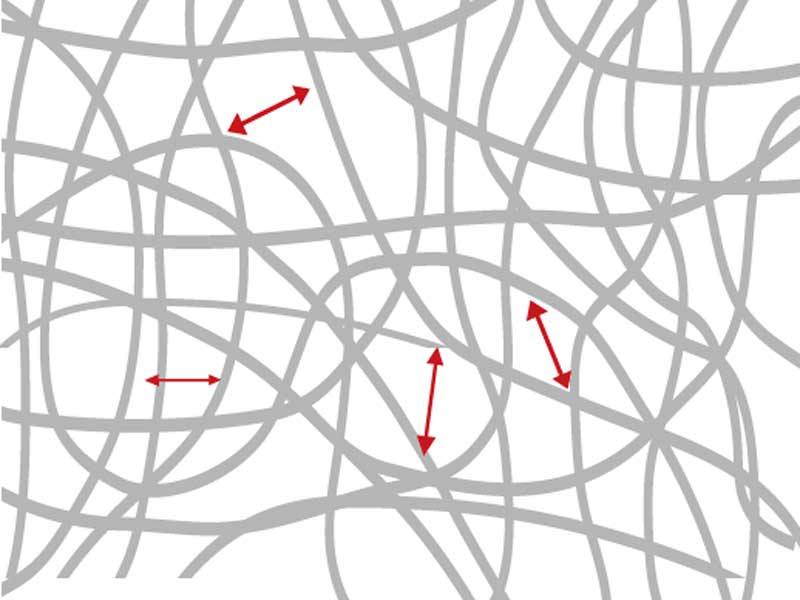
However, the water electret sample exhibited significantly altered morphology. It had a more fluffy appearance with bent and convoluted fibers throughout the matrix.
This is attributed to the high pressure water jets of the water electret process causing fibers to bend and distort. The jet impact and vacuum drawing lead to the bent, convoluted structure.
These morphological changes to the fiber web correlate with the increased pore size distribution. The coarsening from the water electret process increased porosity and pore sizes.
In summary, while the base fiber diameters were equivalent, the water electret treatment uniquely altered fiber structure and morphology leading to enhanced porosity.
Water Electret vs Standard Electret Meltblown Nonwovens FAQ: Key Wondering Questions
5.1 Filtration efficiency after full particle loading
During the particle loading tests, both the water and standard electret meltblown nonwovens experienced temporary dips in efficiency as the electrostatic effect diminished. However, after sufficient loading, filtration efficiency climbed back to 99.9% for both samples as particles deposited in the matrix. This demonstrates that at maximum loading, very high filtration efficiency can be achieved regardless of the electret technology used.
5.2 Why filtration efficiency drops during initial loading stages
The dip in efficiency during early loading is attributed to neutralization of the electret charge on the fibers by the incoming charged NaCl (tested on TSI 8130a) particles. This temporarily diminishes the electrostatic enhancement effect. However, deposited particles soon obstruct pores, transitioning the filtration to physical sieving, causing efficiency to recover.
5.3 Contextualizing lab data versus real-world performance
It is important to note the lab loading conditions represent an accelerated test. In real-world use, loading occurs gradually over much longer timeframes. The electrostatic effect may be sustained longer before physical sieving takes over. However, the lab data remains useful for comparative benchmarking of the different electret technologies.
5.4 Which meltblown is the best for choice
For critical applications where permanent filtration performance is essential, water electret meltblowns are likely the best choice. Their higher initial efficiency, better charge permanence, and sustained properties make them ideal for high-spec filters. However, for some cost-sensitive applications, standard electrets may still be suitable. Consider performance needs, operating conditions, and economics.
Conclusion and Key Takeaways
This comparative evaluation between Water Electret vs Standard Electret Meltblown Nonwovens highlighted several key performance differences:
- Water electret nonwovens exhibited substantially higher initial filtration efficiency, achieving 99.9% versus 96.5% for corona electret.
- Water electret nonwovens maintained stable filtration efficiency when exposed to elevated temperatures up to 110°C. In contrast, corona electret efficiency dropped markedly above 90°C.
- Similarly, water electret efficiency was minimally impacted by high humidity. But corona electret experienced larger degradation.
- Water electret nonwovens had lower initial pressure drop around 19 Pa versus 22 Pa for corona electret, thanks to increased porosity.
- This lower resistance was maintained after thermal and humidity exposure. However, both experienced large pressure increases during heavy particle loading.
Overall, the results clearly demonstrate the superior filtration capabilities of water electret meltblown nonwovens under a wide range of conditions. The water-based charging delivers permanent electrostatic enhancement.
However, it is important to note the lab findings represent accelerated tests. In real-world applications, the performance gaps may be less substantial depending on conditions. Manufacturers should evaluate both technologies per their specific needs.
For highly demanding filtration uses where maximizing performance is critical, water electret technology appears ideal. But for some cost-sensitive high-volume applications, standard corona electret may still sufficiently improve filtration.