
Introduction
What is Water Electret Charging (WEC) ? Water Electret Charging, also known as Hydro Electret Charging, is a crucial process in the production of Water Electret Meltblown, a groundbreaking technology in nonwoven fabric manufacturing. This innovative technique involves applying high-pressure pure water to the meltblown fabric, resulting in the creation of an electrostatic charge. The friction between the water and the fibers generates this charge, imparting remarkable properties to the fabric. Water Electret Charging enhances the charge stability, filtration efficiency, storage lifespan, and air resistance of the meltblown fabric. It ensures a consistent and durable electrostatic charge, allowing for improved filtration performance, reduced air resistance, and longer-lasting effectiveness.
This transformative process is revolutionizing the field of nonwoven technology, opening doors to a new era of enhanced filtration solutions with broad applications in industries such as healthcare, automotive, environmental protection, and more.
In this article, we will try to give you a detailed overview of this WEC process and hopefully give you a basic understanding of how it works and the benefits. Let’s move on.
Background Story: From the Corona Electret Charging Technology
1.1 Traditional electret meltblown has limitations in filtration efficiency and charge stability
Traditional electret meltblown, utilizing the corona electret charging process technology, has been widely adopted in the industry due to its ease of operation and cost-effectiveness. However, this conventional method comes with certain limitations that hinder its ability to meet the ever-increasing demands for higher filtration efficiency and charge stability.
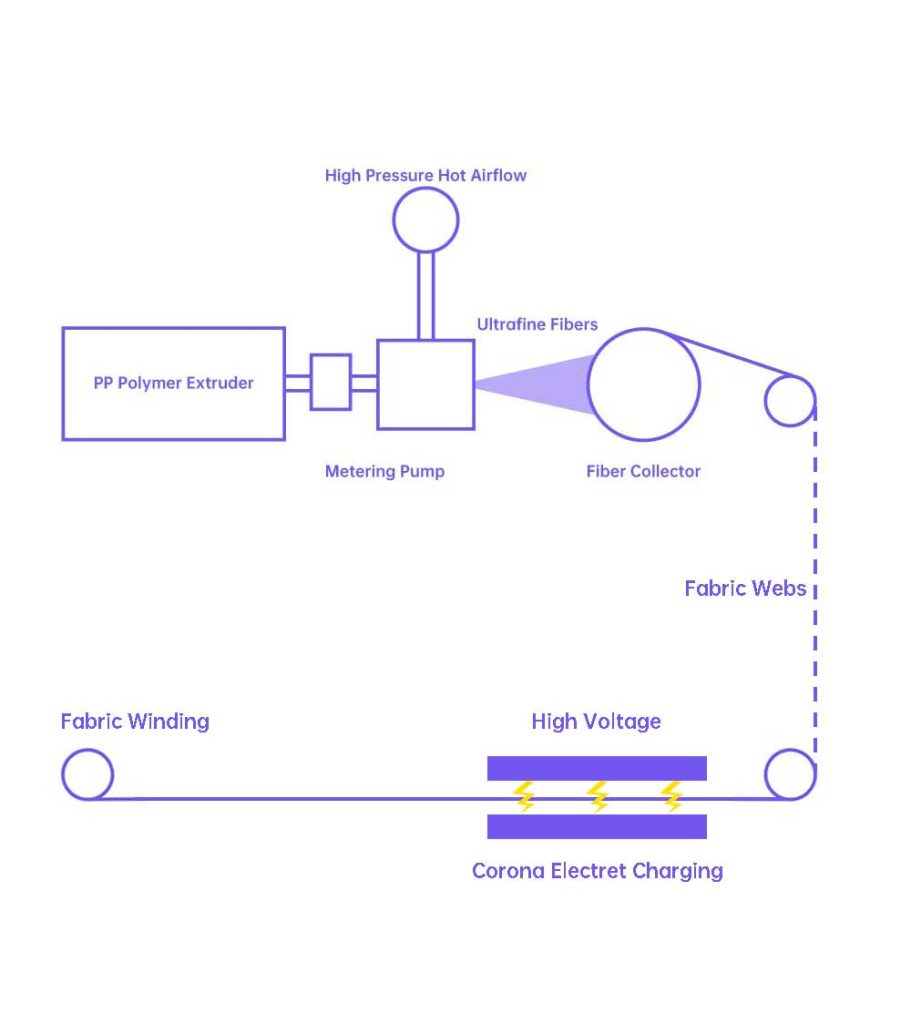
In the corona electret charging process, a high voltage is applied to the meltblown fabric to induce an electrostatic charge, which helps in capturing particles and impurities from the air. While this method is efficient to some extent, it falls short of achieving the stringent requirements of industries that demand superior air filtration capabilities.
The main drawback of traditional electret meltblown is its limited filtration efficiency, typically hovering around 96%. For industries like healthcare, electronics manufacturing, and environmental protection, this level of efficiency may not be sufficient to meet the strict air quality standards and regulations.
Additionally, charge stability poses a significant challenge with the corona electret charging process. Over time, the electrostatic charge on the meltblown fabric tends to degrade, leading to reduced filtration efficiency and performance. This decline in charge stability diminishes the fabric’s ability to effectively trap particles and contaminants, compromising its overall functionality.
To address these limitations and cater to the industry’s growing needs for higher filtration efficiency and charge stability, the Water Electret Charging (WEC) process has emerged as a promising solution. Unlike the traditional corona electret charging process, WEC offers significant advancements in fabric performance, paving the way for improved air filtration technology.
1.2 There is a growing demand for improved processes in the industry
There is a growing demand for improved processes in the industry to meet the diverse needs of various sectors. Among these sectors are healthcare, electronics, high-end manufacturing, and animal husbandry, each of which requires advanced filtration solutions. These solutions must effectively remove contaminants, particulate matter, and harmful substances from the air to ensure safe and clean environments.
Moreover, the demand for materials that offer several advantages has been on the rise. Industries seek filtration solutions that are not only effective but also lighter in weight and healthier for users. Additionally, cost-effectiveness is a significant factor in choosing the right filtration material.
In response to these needs, water electret charging based meltblown nonwovens have emerged as a game-changer. These innovative materials provide superior filtration performance, surpassing the limitations of traditional electret meltblown. WEC-based meltblown nonwovens boast enhanced charge stability, higher air filtration efficiency, and an extended storage lifespan. (For further reading, please check this Paper out: Water electret charging based polypropylene/electret masterbatch composite melt-blown nonwovens with enhanced charge stability for efficient air filtration.)
Furthermore, WEC-based meltblown nonwovens offer significant advantages over traditional glass fiber filter materials. They are not only lighter in weight but also represent a healthier option for various applications. And they are prove to be more cost-effective, making them a highly competitive alternative to glass fiber filters.
Understanding Water Electret Charging: A Close Look at the Process
2.1 The Birth of WEC: What is it and how is it different from traditional methods
Water Electret Charging is a revolutionary technology that has transformed the field of meltblown nonwovens. Developed by the renowned American company 3M, WEC has brought significant advancements in air filtration efficiency and charge stability.
Unlike traditional methods such as corona discharge, this new method utilizes a water-based process to charge the meltblown fabric. High-pressure pure water is ejected through the fabric, creating friction between the water and the fibers. This friction generates static electricity and imparts a stable charge to the fabric.
The development of Water Electret Charging has been a result of extensive research and development efforts by scientists and manufacturers. Through their dedication and perseverance, significant advancements have been made in improving the charge stability and filtration efficiency of meltblown nonwovens. As the technology continues to evolve, wec-based meltblown materials have achieved an impressive air filtration efficiency of up to 99.99%.
The birth of Water Electret Charging marks a significant milestone in the field of nonwoven technology. It has paved the way for the production of lighter-weight, high-performance materials that offer superior filtration capabilities. With ongoing research and development, wec-based meltblown nonwovens are poised to meet the ever-increasing demand for efficient and cost-effective filtration solutions in various industries.
2.2 Before diving into the details of the process: Introducing the Water Electret Masterbatch: the role of the water electret masterbatch in the process
The Water Electret Masterbatch plays a crucial role in the Water Electret Charging process, enabling the efficient and effective electrostatic charging of meltblown nonwoven fabrics. This innovative masterbatch is specially formulated to enhance the charge stability and filtration efficiency of the final product.
So, what exactly is the Water Electret Masterbatch? It is a specialized additive that contains a unique blend of functional materials designed to enhance the electrostatic properties of the meltblown fabric. These materials are carefully selected to provide a stable and long-lasting charge to the fibers, ensuring optimal performance in air filtration applications.
The Water Electret Masterbatch is typically added to the meltblown process as a small percentage of the total polymer weight (3%-5%). During the extrusion process, the masterbatch is evenly dispersed within the polymer matrix (usually PP matrix), ensuring that each fiber is coated with the electrostatically active components. This uniform distribution is essential for achieving consistent charge stability and filtration efficiency throughout the fabric.
This is to say, the meltblown clothes produced by adding water electret masterbatches are not originally electrostatically charged, but the water electret charging process makes them electrostatically charged.
2.3 Before processing: Production of raw meltblown nonwoven webs
Before the Water Electret Charging process takes place, it is essential to understand the production of raw meltblown nonwoven webs. This initial stage involves the transformation of molten polymer into a finely spun web of fibers, which serves as the foundation for the subsequent WEC process.
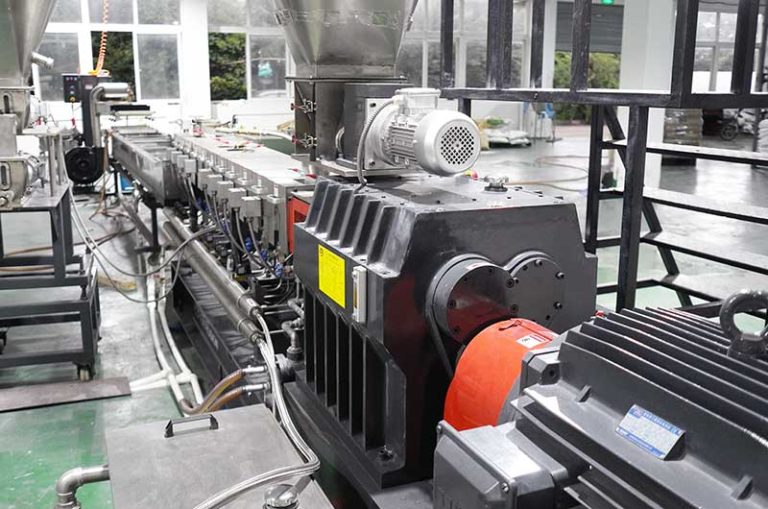
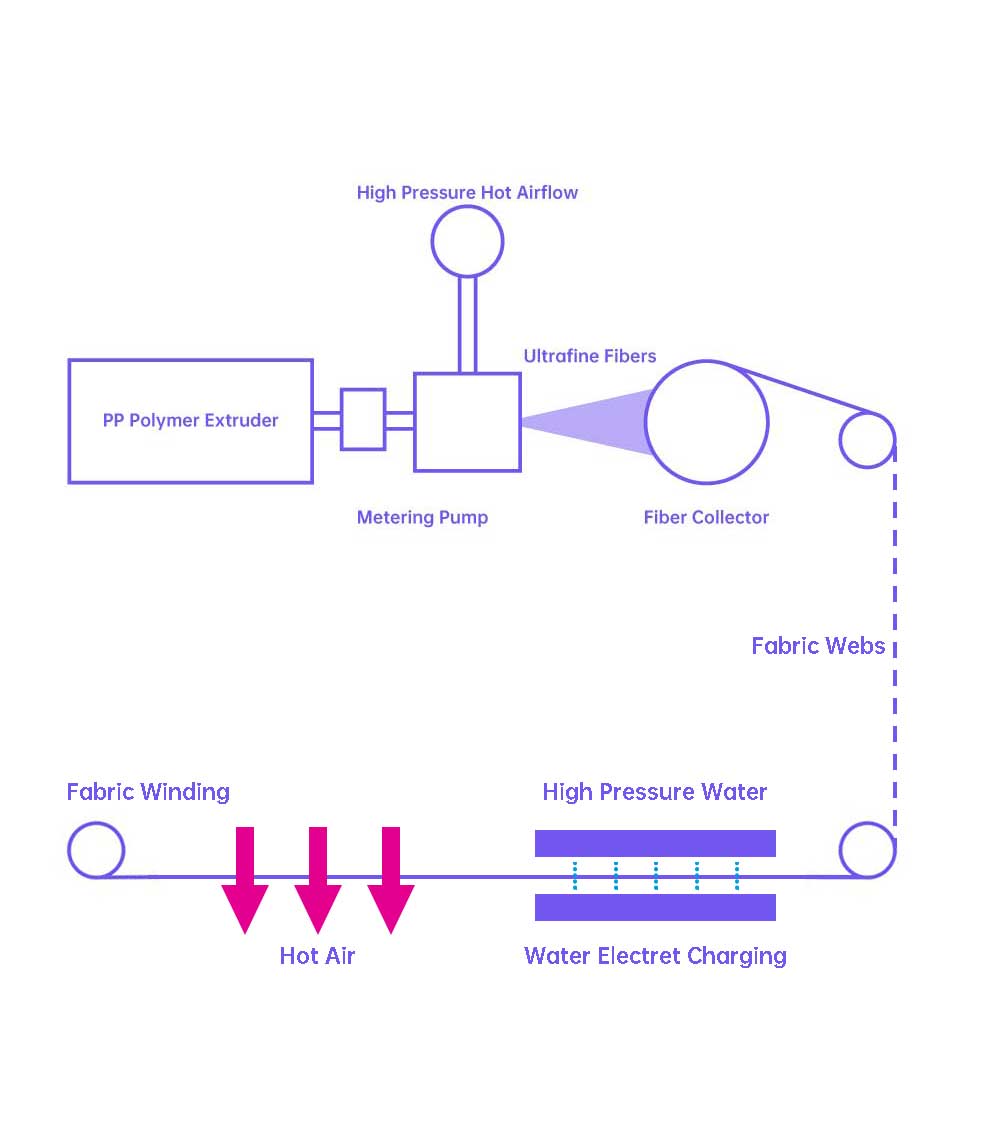
The manufacturing process of meltblown nonwovens begins with the melting of polymer resins. Commonly used polymers include polypropylene (PP) and polyethylene (PE), which are melted at high temperatures until they reach a molten state. The molten polymer is then extruded through a specialized spinneret, a plate with numerous tiny holes arranged in a specific pattern.
As the molten polymer exits the spinneret, high-velocity hot air is introduced to initiate the blowing process. The force of the air stretches and attenuates the polymer strands, resulting in the formation of ultrafine fibers. These fibers are propelled by the air and randomly deposited onto a moving conveyor belt or drum, forming a delicate and porous web.
During the manufacturing process, factors such as air pressure, temperature, and polymer flow rate are carefully controlled to achieve the desired fiber diameter and web thickness. The efficiency of this process is crucial, as it directly influences the filtration performance and overall quality of the meltblown nonwoven material.
Once the web of meltblown fibers is formed, it undergoes further treatment to enhance its properties. This includes processes such as heat setting, where the web is subjected to controlled heating to improve its dimensional stability and strength. And of course, the web will undergo Water Electret Charging process.
2.4 The Water Electret Charging Process: A detailed explanation of the steps involved in water electret charging
The water electret charging process is a crucial step in the production of water electret meltblown nonwovens. It involves several key steps that contribute to the enhanced charge stability and filtration efficiency of the fabric.
The first step in the process is the injection of high-pressure pure water onto the meltblown nonwoven fabric. This high-pressure water creates friction between the water and the fibers, resulting in the generation of electrostatic charges on the fabric’s surface.
As the high-pressure pure water comes into contact with the meltblown fabric, the friction between the water and the fibers causes the fabric to become charged. This charging process enhances the fabric’s electrostatic properties, enabling it to attract and capture particles more effectively during filtration.
After the water electret charging step, the fabric undergoes drying and finishing. During this stage, the fabric is exposed to high temperatures and high humidity. By subjecting the fabric to the first encounter with high temperature and high humidity, the drying and finishing process contributes to the overall quality and performance of the water electret meltblown nonwovens. It ensures that the fabric maintains its desired characteristics, including improved charge stability, filtration efficiency, and longer storage lifespan.
And after drying, the meltblown webs would be wound and packed, completing the production process of water electret meltblown cloth.

The Benefits of WEC in Optimizing Fabric Properties
3.1 Reliable Charge Stability: How WEC maintains a consistent electrostatic charge for improved performance
Water Electret Charging ensures a remarkable advantage in maintaining a reliable charge stability in the meltblown nonwoven fabric. This stability is crucial for the long-term effectiveness of the filtration process. The process involves several key steps that contribute to the consistent electrostatic charge.
One of the key factors is the generation of deep trap charges during the process. When high-pressure pure water is injected into the system, friction occurs between the water and the polymer, leading to the creation of deep traps within the meltblown fabric. These deep traps play a vital role in preserving the electrostatic charge for an extended period, ensuring the fabric’s filtration efficiency remains high over time.
Furthermore, the hot drying process during manufacturing plays a pivotal role in removing surface charges that may cause instability. The exposure to high temperature and humidity allows the fabric to shed any surface unstable charges, leaving behind a stable and reliable electrostatic charge. This process further enhances the charge stability, ensuring the fabric performs consistently even in challenging environments.
The combination of deep trap charges generated through friction and the hot drying process contributes to the exceptional charge stability of WEC-based meltblown nonwovens. This reliability sets them apart from traditional methods and makes them a preferred choice in various industries, including healthcare, electronics, and high-end manufacturing.
3.2 Ultrafine Fiber: How WEC leads to ultrafine fiber and its impact on pore size, porosity, dust holding capacity, and air resistance
The Water Electret Charging process plays a crucial role in the production of ultrafine fiber meltblown nonwovens. Through the combination of water electret masterbatch (WEMB) and high-pressure water injection, this innovative technique creates a fine fiber structure with exceptional properties.
During the process, the high-pressure water jet passes through the fiber web, causing the original pore structure to expand and form larger openings. This modification results in an increased pore size, allowing for improved airflow and better particle capture efficiency. The larger pores enhance the permeability of the fabric, reducing air resistance and enabling a smoother flow of air through the filter.
Additionally, the larger pore size contributes to higher porosity, creating a more open and interconnected network of fibers. This characteristic enhances the filter’s ability to capture and retain particles, dust, allergens, and other contaminants. The increased surface area provided by the larger pores allows for greater particle entrapment, leading to improved filtration efficiency and a longer lifespan for the filter.
Furthermore, the larger pore size offers benefits in terms of dust holding capacity. The expanded pore structure provides more space for particles to be trapped and held within the fabric, reducing the risk of particle breakthrough and maintaining consistent performance over time. This feature is particularly advantageous in environments with high dust or pollutant concentrations, such as industrial settings or areas with heavy air pollution.
Overall, the combination of Water Electret Masterbatch and the high-pressure water injection of Water Electret Charging process leads to the production of ultrafine fiber meltblown nonwovens. These materials offer benefits such as better pore size, higher porosity, improved dust holding capacity, and lower air resistance. By incorporating WEC technology, manufacturers can create lightweight, high-performing filters that outperform traditional materials and provide healthier and more efficient air filtration solutions.

Conclusions
4.1 Significance of Water Electret Charging: The importance of WEC in revolutionizing nonwoven technology
The Water Electret Charging process has emerged as a game-changer in the realm of nonwoven technology, revolutionizing the performance and capabilities of meltblown fabrics. With its unique approach and remarkable results, WEC holds immense significance in various industries and applications.
Traditionally, electret meltblown fabrics have faced limitations in terms of filtration efficiency and charge stability. However, WEC addresses these challenges head-on, offering a transformative solution. By introducing deep trap charges through friction and utilizing a hot drying process to remove surface unstable charges, WEC ensures reliable charge stability, maintaining a consistent electrostatic charge over extended periods. This breakthrough innovation ensures that the fabric continues to perform optimally, delivering exceptional filtration efficiency and capturing even the smallest particles.
Furthermore, WEC enables the production of meltblown nonwovens with ultrafine fibers. The high-pressure water injection during the process leads to the formation of larger pores within the fabric, increasing porosity and improving dust holding capacity. This, coupled with lower air resistance, results in superior filtration performance, making WEC-based meltblown nonwovens highly sought-after in various industries.
The impact of WEC on nonwoven technology cannot be overstated. Its ability to enhance filtration efficiency, maintain reliable charge stability, and produce ultrafine fibers with larger pore size and higher porosity sets a new standard in the industry. As research and development in WEC continue, further advancements are expected, pushing the boundaries of WEC based meltblown fabric products in a variety of industries.
4.2 Future development and potential: 99.9999% filtration efficiency possibility and start to take a look at the glass fiber filter market
As Water Electret Charging continues to advance and evolve, the future of nonwoven technology looks incredibly promising. With the current filtration efficiency already reaching an impressive 99.99%, researchers and manufacturers are diligently working towards achieving the coveted 99.9999% level of filtration efficiency. Such extraordinary efficiency would make WEC-based meltblown nonwovens highly sought-after for critical applications in healthcare, electronics, and other high-end industries.
The progress made in Water Electret Meltblown (WEMB) and WEC is opening up possibilities for nonwovens that can compete directly with glass fiber filters, long regarded as the gold standard in air filtration. As WEC-based meltblown nonwovens boast both lighter weight and health-friendly properties, they offer an enticing alternative to traditional glass fiber filters. The potential to provide outstanding filtration performance without the drawbacks of heavier materials or potential health concerns puts WEC in a strong position to disrupt the high-end filtration market.
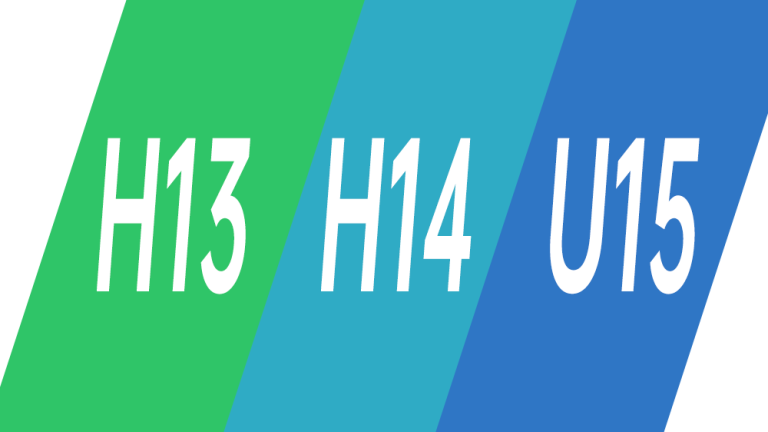
Researchers are already exploring new avenues to optimize the WEC process further. By enhancing the water electret masterbatch and refining the charging techniques, the nonwoven industry is on the brink of reaching filtration efficiencies previously considered unattainable. The vision of achieving U15, U16, or even U17 levels of filtration efficiency, which are reserved for the most stringent air purity requirements, is becoming more plausible with each breakthrough.
The future of Water Electret Charging not only lies in improved filtration efficiency but also in diversifying its applications across various industries. As the technology matures, we can expect to see WEC-based nonwovens finding their way into innovative products, ranging from advanced air filters and respirators to cutting-edge healthcare textiles.
The revolutionary Water Electret Charging process is pushing filtration efficiency of water electret meltblown to new heights. And if you want free water electret masterbatch samples, please contact, EP-6 and EP-300 Water Electret Masterbatch series are both available.